
Safety Training Video Case Study
Every flatbed that enters TOTE Maritime Alaska's Tacoma and Anchorage terminals is inspected before it boards. Cargo that meets the federal highway standard can still fail that inspection, because a ship moves in six directions a highway never does. This safety training video, a five-minute animated securement procedure piece for TOTE's warehouse teams and shippers, exists to close that gap.
The script was written from TOTE's own securement manual, page references included, and reviewed by the client through five drafts before a frame was animated. Every rule appears as on-screen text timed to the narration, so a worker can pause on the line they need.
:quality(75))
Trusted by leading organizations
:quality(75))
:quality(75))
:quality(75))
:quality(75))
:quality(75))
:quality(75))
:quality(75))
:quality(75))
:quality(75))
:quality(75))
TOTE Maritime Alaska – Securement procedure training
TOTE Maritime Alaska carries freight between Tacoma and Alaska. Flatbed cargo that arrives at its gate has usually been secured to the federal highway standard, 49 CFR Parts 392 and 393, and the video says plainly that this is a starting point, not a pass. Ocean transport exposes freight to forces it never meets on the road, which is why TOTE's securement standards go beyond the highway rules and why loads are inspected before entry.
Motifmotion produced a single animated training video that walks a worker through the three load types that cover most incoming cargo: general cargo flatbed, pipe loads and structural steel. Each becomes a chapter with its own rules on straps, unitization, belly wraps, chocks, dunnage and construction. The project began as a two-and-a-half-minute piece and grew to more than five minutes once the client saw how much of the manual the format could carry. It is the model for our safety training video production: animate the failure mode, put the rule on screen, and build from the client's documented procedures.
Securement procedure training
Built from the securement manual, page by page
The narration runs to about 800 words, and almost every sentence is a rule: use straps rated for the load, keep them flat and untwisted, use softeners on sharp edges, keep straps and chains inside the rub rails. Each one came from a numbered page of the manual and each one is shown as text while it is spoken.
That is a different job from an explainer. Nobody needs to be persuaded that securement matters. They need the exact requirement, in the order they will meet it on the deck, in a form they can check against the load in front of them. The client's review rounds were spent on precision, down to which side of a tire the chock sits.
- Every rule traced to a page in TOTE's securement manual
- Rules appear as on-screen text, timed to the narration
- Five script drafts reviewed and approved by the client before animation
- One chapter per load type, so a worker can jump to the load in front of them
:quality(75))
Have a procedure your crews have to get exactly right?
Securement, lockout/tagout, PPE, confined space: if the rule lives in a manual nobody reads on the floor, tell us which one and we will show you how it looks as a module.
Why the hazard had to be animated
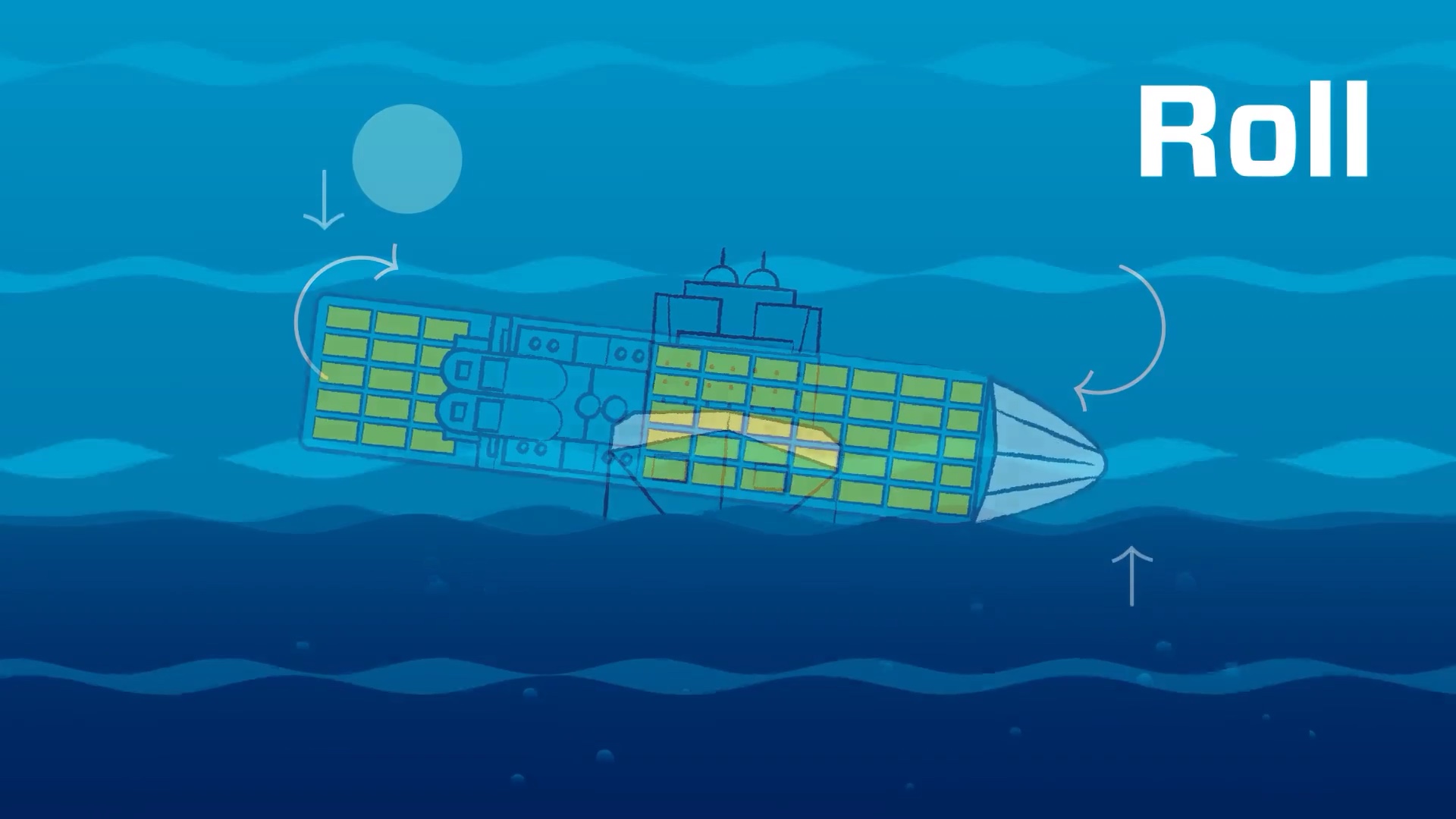
The hardest idea in the video is the one that cannot be filmed: how drastically a load moves during ocean transit. The client asked for a standalone flatbed on a ship, moving through all six motions at once. Animation is the only way to show it without putting a load, or a person, at risk.
The same logic runs through the smaller rules. Heavier pieces on the bottom, lengthwise bundles touching or spaced with dunnage, wedge blocks nailed at ninety degrees: each is a still from the manual turned into a short motion, so the worker sees the consequence of getting it wrong before the rule is stated.
- Pitch, roll, yaw, heave, sway and surge shown on a single flatbed
- The reason ocean securement exceeds the highway standard, made visible
- A center of gravity within 96 inches of the deck, drawn rather than described
- Downward pressure on every cargo unit, shown with the arrows a worker will picture later
:quality(75))
Three loads, one visual system
Each chapter opens on a page of the manual, then moves onto the same illustrated flatbed. The straps, chocks, dunnage and blocking are drawn once and reused, so a worker who has watched the pipe chapter already recognizes the parts when the steel chapter starts. It is the same principle behind every training series we build: the visual system is the asset, and the second module is cheaper than the first.
The video closes on the manual itself and on how to reach TOTE's operations team, including sending load photos for review before arriving at the gate. Training that ends with the next step tends to get used.
- Load 1: general cargo flatbed, strap requirements, unitization, construction
- Load 2: pipe loads, belly wraps and chocks
- Load 3: structural steel, dunnage and construction
- One illustrated deck, one set of icons, reused across every chapter
:quality(75))
Related case studies
:quality(75)) Roadway safety
Roadway safetyIIR: National roadway safety
Institute for Intergovernmental ResearchEight animated roadway-safety episodes for a national law-enforcement program, each built on a single statistic cited on screen.
:quality(75)) Training / Compliance
Training / ComplianceA modular compliance training series built for consistent rollout across a distributed workforce.
:quality(75)) Customer education
Customer educationBGE: Residential modification and relocation
Baltimore Gas and ElectricA nine-module instructional series that walks homeowners through a gas or electric service change, one phase at a time.
:quality(75))
Ready to build safety training your crews will use?
The rule your team has to get right is probably already written down. Motifmotion turns it into a module they can check against the load in front of them. Contact us in a few different ways:
We'll work with you to understand your objectives, how we can provide assistance and we'll outline the next steps.